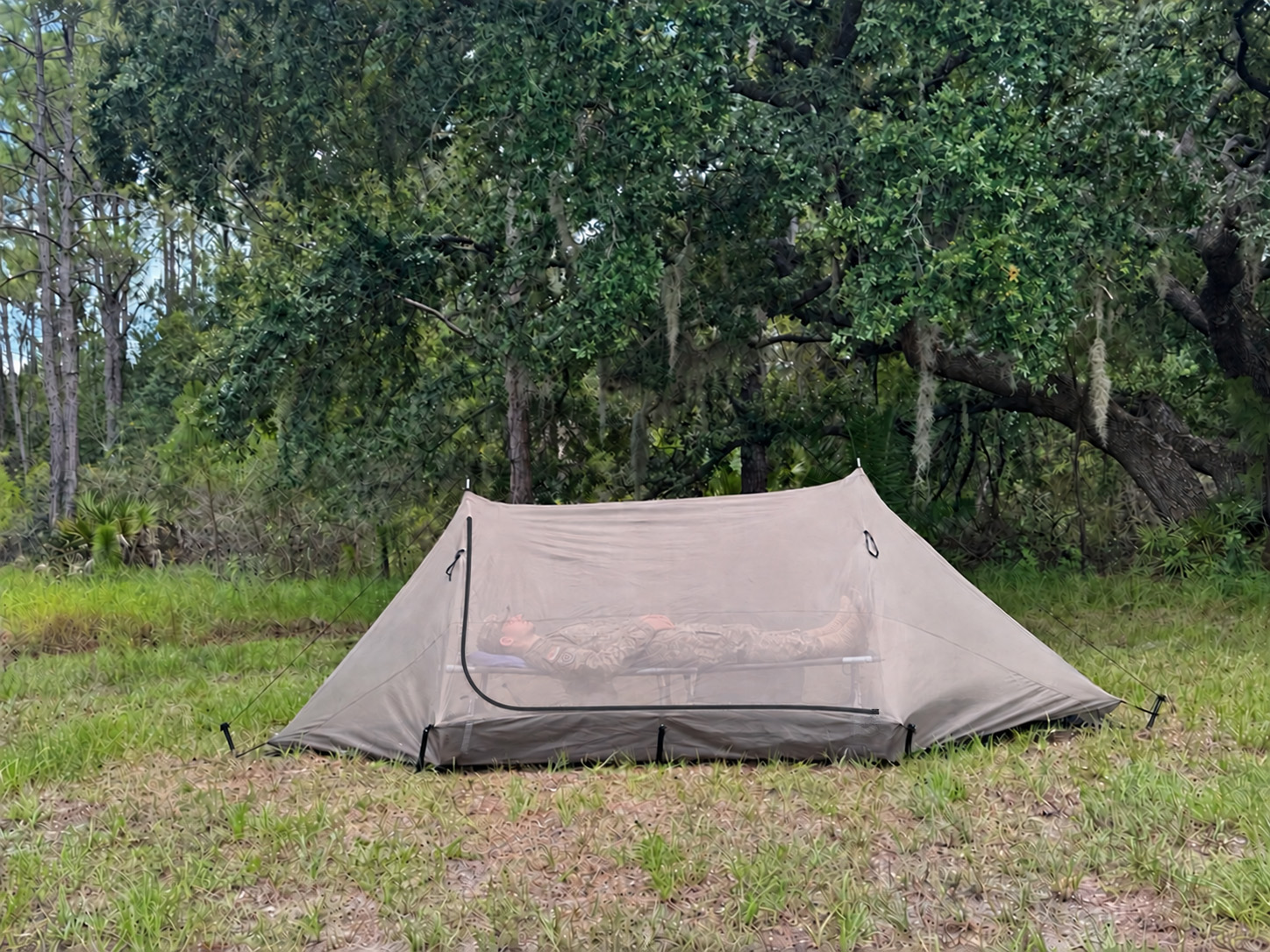
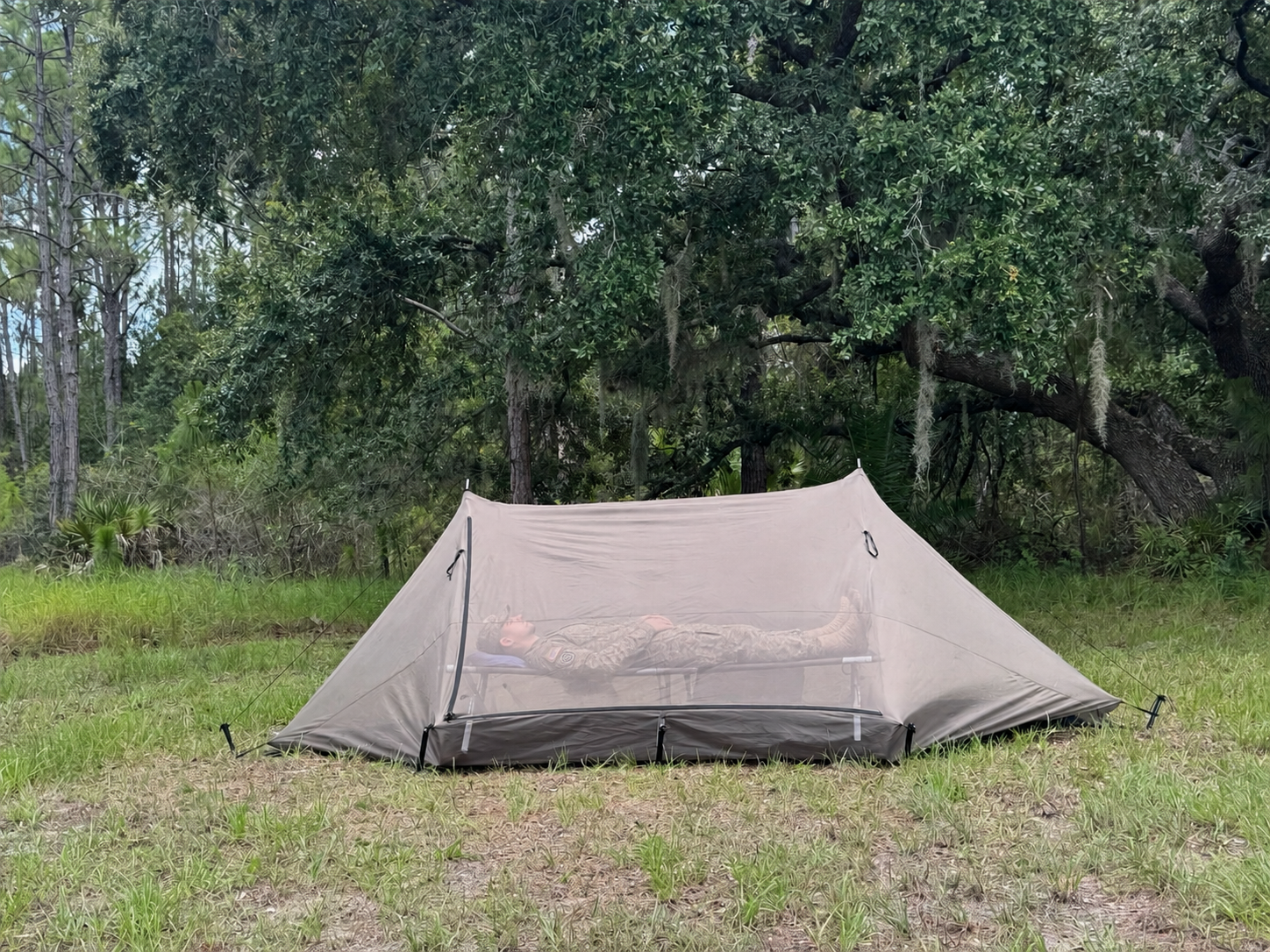
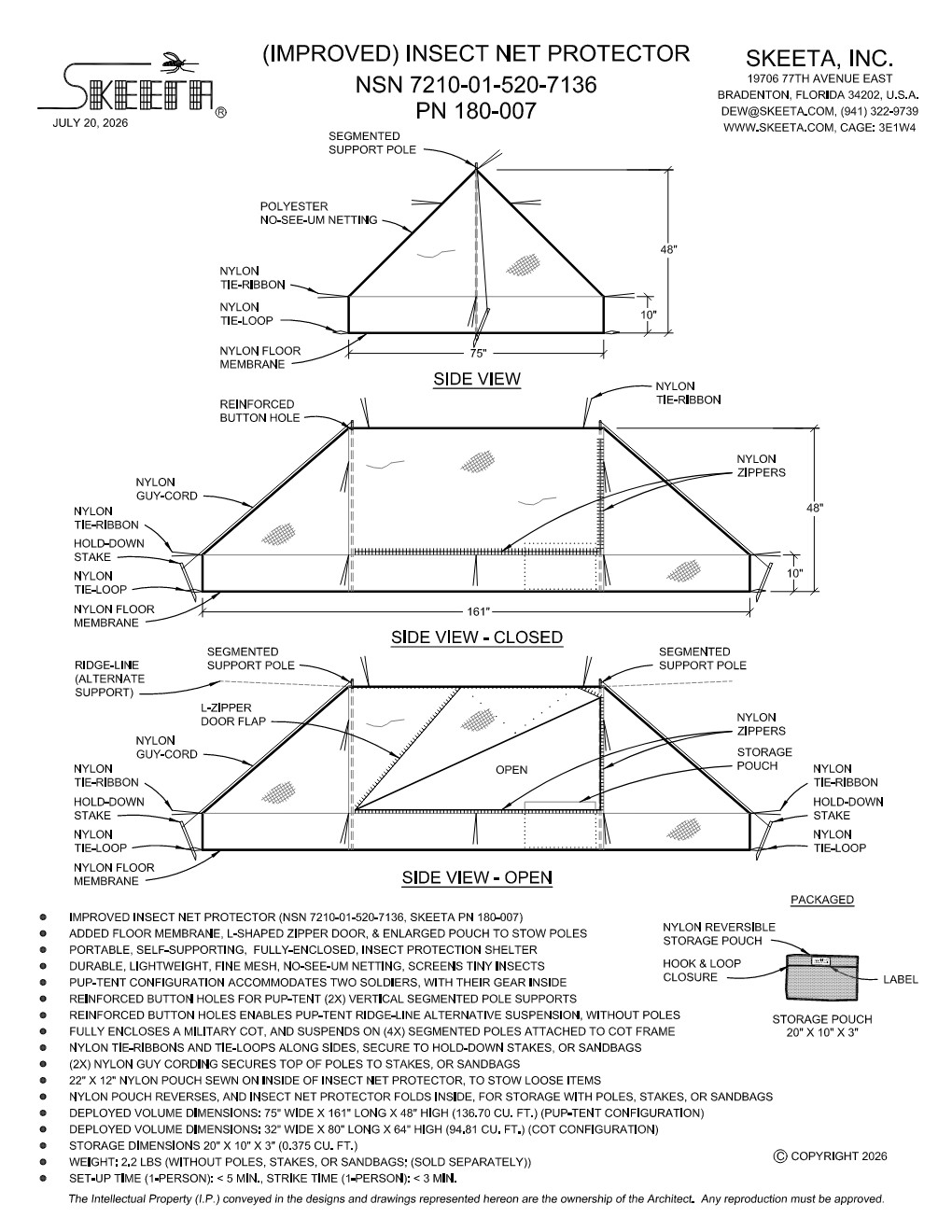
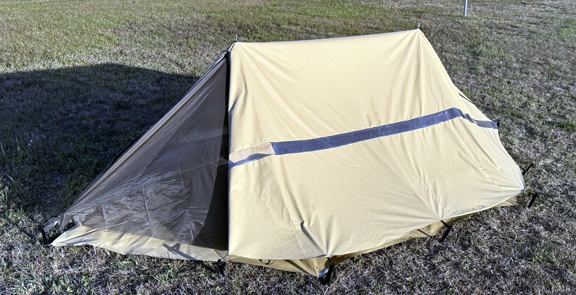
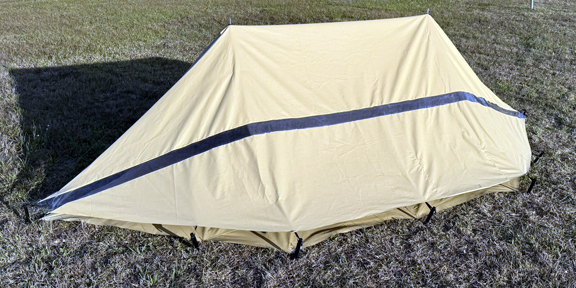
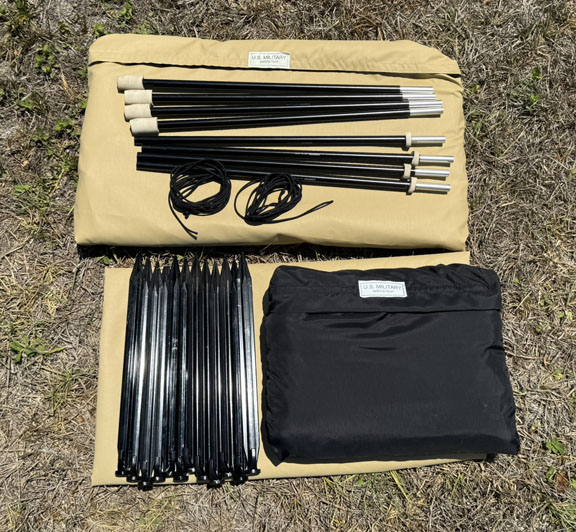
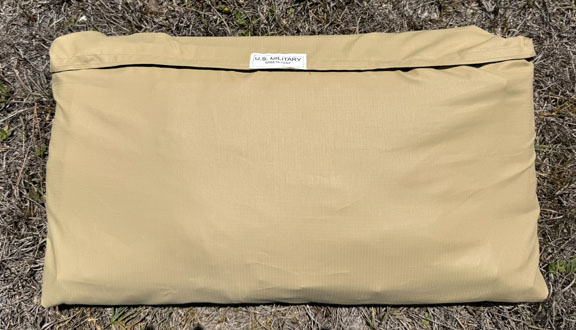
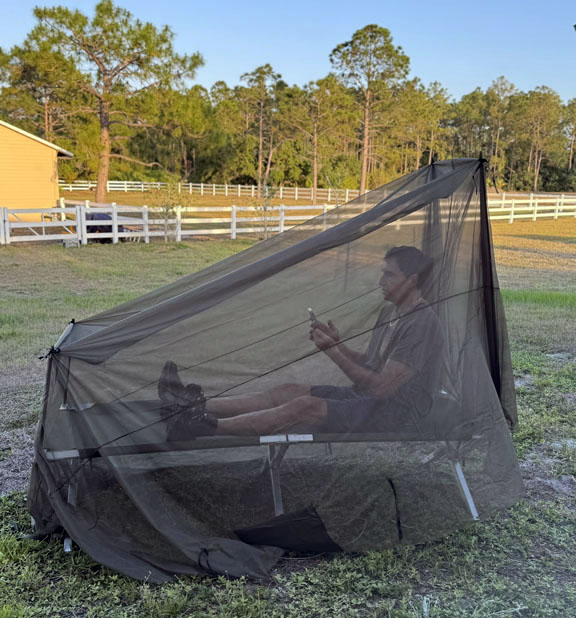
The Improved Insect Net Protector (Skeeta Bednet) is a lightweight, man-portable, fully enclosed personal insect protection shelter that improves upon the legacy Insect Net Protector (NSN 7210-01-520-7136, PN 180-007), by adding an integrated floor membrane, fine no-see-um mesh, a large L-shaped side zipper door, compact segmented poles, and multiple hold-down options. The enclosure protects the Soldier, sleeping system, cot, and essential gear from mosquitoes, midges, ticks, chiggers, ants, spiders, and other biting or nuisance pests during rest, recovery, and sleep periods
The Skeeta Improved Insect Net Protector is a lightweight, man-portable, fully enclosed personal insect protection shelter that improves the legacy Insect Net Protector (NSN 7210-01-520-7136, PN 180-007) by adding an integrated floor membrane, fine no-see-um mesh, a large L-shaped side zipper door, compact segmented poles, and multiple hold-down options.
The enclosure protects the Soldier, sleeping system, cot, and essential gear from mosquitoes, midges, ticks, chiggers, ants, spiders, and other biting or nuisance pests during rest, recovery, and sleep periods. Six straight pole sections assemble into two vertical supports for a 48-inch-high pup-tent configuration. The protected floor area is approximately 75 inches x 161 inches (61.46 sq. ft.) with approximately 136.70 cu. ft. of enclosed volume, large enough to fit a cot and gear. Eight 12-inch PVC stake hold-downs secure the system outdoors with two nylon guy lines; eight sandbag hold-downs allow use where staking is not permitted and support indoor use in billets, hangars, aid stations, or temporary facilities. The system stores in an attached pouch approximately 20 inches x 10 inches x 3 inches (0.375 cu. ft.). Total packed weight with poles and hold-downs is approximately 3.5 lb.; the net protector alone weighs approximately 2.2 lb. and can be deployed with a ridge line and field-improvised hold-downs to reduce carried weight.
At Maneuver Trials, dismounted infantry Soldiers can carry and employ the Skeeta Improved Insect Net Protector as individual protective equipment during patrol-base operations, tactical pauses, overnight rest, observation posts, field recovery periods, and temporary indoor billeting. The system requires no power, batteries, vehicle support, radio link, or electromagnetic emission. . It can be evaluated at the individual Soldier, squad, and platoon levels for setup time, packability, cot and gear compatibility, ventilation, ease of entry/exit, and Soldier confidence during rest in pest-exposed environments. Recommended basis of issue for field validation: one system per Soldier, with alternate deployment configurations tested under realistic light/dismounted conditions.
1. Net only (2.2 lb.): carried in a backpack and deployed with a ridge line and field-improvised hold-downs for the lightest field configuration.
2. Net with six pole sections and eight stake hold-downs (approximately 3.5 lb.): backpack-carried and deployed outdoors in a self-supporting pup-tent configuration.
3. Net with six pole sections and eight empty sandbag hold-downs (approximately 3.4 lb.): deployed where staking is not permitted, including hard ground, indoor spaces, or temporary facilities.
4. Net with eight pole sections and no separate hold-downs (approximately 2.6 lb.): deployed around a standard military cot in the field or indoors for cot-based rest and recovery.
Dismounted Soldiers often rest in field environments where mosquitoes, midges, ticks, chiggers, biting flies, ants, wasps, spiders, and other pests can penetrate sleep and recovery areas. Bites and stings can degrade health, sleep quality, alertness, comfort, and mission readiness; some vectors can transmit debilitating diseases such as Lyme disease, Rocky Mountain spotted fever, ehrlichiosis, and West Nile virus. Repellents and uniform treatments are valuable, but they do not create a sealed physical barrier around the Soldier and essential gear during sleep or recovery. Open-floor legacy netting can leave ground gaps, permit crawling pests, and require cot poles or improvised support. The Skeeta Improved Insect Net Protector addresses this capability gap with a fully enclosed, fine-mesh protective volume, attached floor membrane, large zipper entry, compact pole system, and flexible stake, sandbag, cot-frame, or ridge-line deployment. The intended military benefit is improved personal protection, better rest, reduced preventable pest exposure, and greater Soldier confidence in austere environments.
TRL 6 – field-tested prototype based on an existing issued Insect Net Protector configuration, with integrated improvements ready for Soldier evaluation in an operationally relevant field environment
Maneuver Trials 2027 Objective: Demonstrate and collect Soldier feedback on whether the Skeeta Improved Insect Net Protector provides a lightweight, rapidly deployable, fully-enclosed personal insect-protection capability for dismounted infantry without power, batteries, vehicles, or electromagnetic-spectrum dependence. Trial objectives are:
1. Measure one-Soldier setup and pack-up time for each deployment configuration.
2. Assess packability, carried weight, and suitability for light/dismounted infantry operations.
3. Evaluate protected volume for a Soldier, sleeping system, optional cot, and essential gear.
4. Assess the floor membrane, L-shaped zipper entry, ventilation, visibility, and ease of use with field clothing and equipment.
5. Compare stake, sandbag, cot-frame, and ridge-line deployment options in field and indoor conditions.
6. Identify durability, snag, repair, cleaning, storage, and user-interface issues after Soldier handling.
7. Compare Soldier preference and perceived protection against the legacy open-floor/coarse-mesh/wooden cot-pole Insect Net Protector configuration.
8. Determine recommended basis of issue and modifications needed before production or Army fielding.
Now we know that if the earthly tent we live in is dismantled, we have a building from God, an eternal house in heaven, not built by human hands. 2 For in this tent we groan, longing to be clothed with our heavenly dwelling, 3 becausewhen we are clothed,we will not be foundnaked.4 So while we are in this tent, we groan under our burdens, because we do not wish to be unclothed but clothed, so that our mortality may be swallowed up by life.
Arctic Food and Fresh Ice Security in Community Ice Cellars
Ice Cellar Experimental Research Tunnel (ICERT) in Fairbanks, Alaska will address the urgent need for food security in Arctic regions where ice cellars are being compromised by permafrost thaw due to global warming.
A permafrost tunnel will be excavated and a bermed pond created above a portion of the tunnel to measure and computer model the thermal effects from adding water to the surface, and storing ice inside the cellar.
The design will incorporate thermal siphons, and air vents to draw-in cold winter air and evacuate heat.
Ice blocks will be harvested from the fresh water pond, and placed inside the ice cellar to maintain below freezing temperature.
Indigenous knowledge of food preservation will be built upon to advance research and fill gaps in science for food and fresh ice security.
WATER ABOVE: Adding water on top of a portion of the tunnel to measure and computer model the thermal changes to the permafrost. Fresh water will be filled from a well into a pond, and water will be channeled through a ditch into Cripple Creek that meanders accross another zone above the ice cellar.
WATER INSIDE: Fresh ice will be havested from the pond and bought into the tunnel to measure the cooling effects.
FOOD STORAGE: Food storage lockers inside temperature controlled air vaults
PUBLIC TOURS: The public will have access inside the ice cellar for educational tours.
A plane is a flat surface that extends into infinity. It is also known as a two-dimensional surface. A plane has zero thickness, zero curvature, infinite width.
Arabicon Associated Consultants was a partnership formed in the sixties, to architect the town planning and engineering for the city of Abu Dhabi, Trucial States of the Oman Arabian Gulf, as commissioned by the Ruler H.H. Sheikh Shakhbout Bin Sultan Al Nahyan, prior to, and concurrent with it becoming the capital of the newly established United Arab Emirates (UAE).
The following is the personal archive folder of Alfred George; the Architect of Arabicon Associated Consultants, and the exclusive Town Master Planner of Abu Dhabi, with his partner Derek Crawford Davies
First Draft Deed of Partnership for Arabicon Associated Consultants between Alan Barnett Grant, Alfred George, Derek Crawford Davies and Ian Duncan Stuart Cuthbert – June 22, 1966
Alfred George‘s town planning design is the first to reshape the Abu Dhabi coastline – 1967
Draft Agreement Between Arabicon Associated Consultants and Alan Grant & Partners – December 15, 1966
Alfred George‘s town planning design is the first to reshape the Abu Dhabi coastline – 1967
Draft Release and Discharge – December 16, 1966
Alfred George‘s town planning design is the first to reshape the Abu Dhabi coastline – 1967
Draft Partnership Agreement for Arabicon Associated Consultants – December 16, 1966
Solicitor’s Letter to Mr. Davies regarding Arabicon – Abu Dhabi – June 22, 1966
On a Sunday in Abu Dhabi (circa 1980), while Alfred George was there to reconcile his outstanding “Town Planning Claim”, (that remains unresolved to this day), he sent a post card to his sister Rose, stating:
“When I designed this road (Airport Road) there was not a tree in sight.” ~ Alfred George Architect and Town Planner
Solicitor’s Cover Page to Engrossments of Agreements regarding Arabicon Associated Consultants – April 7, 1967
Staff as of June 1, 1969 – Proportion of Settlements of Persons Leaving New Practice Chargeable to Old – Appendix D
Accounts to be settled, owed by Old Practice, as at May 31, 1970 – Appendix A
Accounts incurred by Old Practice, Settled by New Practice submitted after May 31, 1970 – Appendix B
I.D.S. Cuthbert Statement of Items to be Reimbursed
Letter to Arabicon Associated Consultants Old Practice
Statement of Expenditures Incurred on behalf of Old Practice to be Reimbursed to New Practice
Alfred George‘s Notes regarding Decisions taken in Abu Dhabi trip – May 22 – 26, 1970
Is Line #4 “A. G. (Alfred George) to arrange replacement for J. E. soonest”, a reference to (John Elliot) mentioned in the paper Planning Abu Dhabi: From Arish Village to a Global, Sustainable, Arab Capital City – that makes no mention of Alfred George whatsoever; the Exclusive Architect and Town Master Planner for his client Arabicon Associated Consultants?
Statement of Expenditures – June 1970
Draft Contract for Consultants – 1967
Mechanical & Electrical Services Consultants, working in association with Arabicon Associated Consultants – Kenneth Stead & Partners
Quantity Surveyors working in association with Arabicon Associated Consultants – Markahm Tillyard Partnership
Alan Grant & Partners Civil and Structural Engineers, a member of Arabicon Associated Consultants
Letter to Derek C. Davies
CONFIDENTIAL Letter to Bank – September 23, 1970
CONFIDENTIAL Letter to Bank – September 23, 1970
Reconciliation between financial status accepted on May 22, 1970 & actual status – October 4, 1970
Letter to Alfred George regarding Unpaid Fees Due for Architectural Design, Town Planning, & Engineering Services Rendered, and “The Town Planning Claim has not yet been investigated” – October 5, 1970(still…)
Letter to Alfred Georgeregarding Unpaid Fees Due for Architectural Design, Town Planning, & Engineering Services Rendered. – October 7, 1970
Memorandum to I. D. S. Cuthbert & D. C. Davies – October 11, 1970
Letter to Alfred George for New Resident Partner A. F. Harrison – December 19, 1970
Alfred George’s Notes regarding Abu Dhabi, etc. – December 28, 1970
Fair Use Disclaimer under Section 107, Copyright Act of 1976. Disseminating the archive folder of Alfred George, the Architect of Arabicon Associated Consultants – for Educational Purposes.
The Alaska School of Permafrost Architecture (ASPA) will advance food and fresh ice security, by urgently filling gaps in scientific knowledge, pertaining to the dynamics of permafrost freeze and thaw, due to added surface and subsurface hydrology, within a Permafrost Tunnel / Ice Cellar in Fairbanks, Alaska.
When Jesus had washed their feet and put on His outer garments, He reclined with them again and asked, “Do you know what I have done for you? 13 YoucallMeTeacherandLord,andrightlyso,becauseI am.14 So if I, your Lord and Teacher, have washed your feet, you also should wash one another’s feet.
If anyone thinks he is something when he is nothing, he deceives himself. 4 Each one should test his own work. Then he will have reason to boast in himself alone, and not in someone else. 5 Foreach oneshould carryhis ownload.6 Nevertheless, the one who receives instruction in the word must share in all good things with his instructor. 7 Do notbe deceived:Godis notto be mocked.Whatevera mansows,he will reap in return.8The one who sows to please his flesh, from the flesh will reap destruction; but the one who sows to please the Spirit, from the Spirit will reap eternal life.
But you are not to be called ‘Rabbi,’ for you have one Teacher, and you are all brothers. 9 And do not call anyone on earth your father, for you have one Father, who is in heaven. 10 Norare you to be calledinstructors,foryouhaveoneInstructor,theChrist.11 The greatest among you shall be your servant.
The Jews were amazed and asked, “How did this man attain such learning without having studied?” 16 “MyteachingisnotMy own,” Jesusreplied.“It comesfrom Him whosentMe.17 If anyone desires to do His will, he will know whether My teaching is from God or whether I speak on My own.
Give, and it will be given to you. A good measure, pressed down, shaken together, and running over will be poured into your lap. For with the measure you use, it will be measured back to you.” 39 Jesus also told them a parable: “Can a blind man lead a blind man? Will they not both fall into a pit? 40 A discipleisnotabovehisteacher,buteveryone who isfully trainedwill belikehisteacher. 41 Why do you look at the speck in your brother’s eye, but fail to notice the beam in your own eye?
We have different gifts according to the grace given us. If one’s gift is prophecy, let him use it in proportion to his faith; 7 if it isserving,let him serve;if it isteaching,let him teach;8 if it is encouraging, let him encourage; if it is giving, let him give generously; if it is leading, let him lead with diligence; if it is showing mercy, let him do it cheerfully.
and INSECT NET PROTECTOR, “Relax, you’re two tents.”
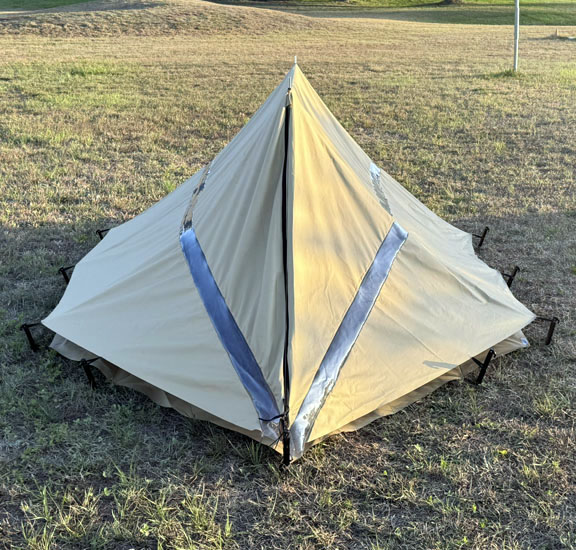
The Skeeta Field Tent is a 2024 USAMRDC “New Product Idea” (NPI) that improves upon the proven military issue 2-Man Half Tent (retired); incorporating versatile new design features, utilizing modern, durable, and lightweight materials, to enable deployment of the current military issue Insect Net Protector (NSN 7210-01-520-7136, PN 180-007) in the “Field” configuration, suspended from inside the Skeeta Field Tent.
The Skeeta Field Tent and the Insect Net Protector can be deployed separately in two configurations; either in the “Cot Type”, draped over vertical segmented poles fastened to the four corners of a cot, or supported on two vertical segmented poles in the “Pup-Tent”, Field configuration. Additional features include a water-resistant separate floor, a clear film, horizonal window band, and an attached stowage pouch, for all Berry Amendment compliant components.
Improved Proven Equipment – Skeeta Field Tent and Insect Net Protector, {2 Tents in 1}
DEW v BLM pursuant to (26 Stat. 391; 43 U.S.C. § 945) – Reservation in patents of right-of-way for ditches or canals, (31 Stat. 790; 43 U.S.C. § 959) – Rights-of-way for electrical plants, etc., and U.S. Patent #1233649.
La Sagrada Familia means “The Holy Family” in English. The church is designed to honor Jesus’ family, with towers representing him, his mother, the four evangelists, and the twelve apostles.
The Basílica i Temple Expiatori de la Sagrada Família,[a] shortened as the Sagrada Família, is an unfinished church in the Eixample district of Barcelona, Catalonia, Spain.
It is the largest unfinished Catholic church in the world. Designed by architect Antoni Gaudí (1852–1926), his work on Sagrada Família is part of a UNESCOWorld Heritage Site.[7]
On 19 March 1882, construction of the Sagrada Família began under architect Francisco de Paula del Villar. In 1883, when Villar resigned,[7]
Gaudí took over as chief architect, transforming the project with his architectural and engineering style, combining Gothic and curvilinear Art Nouveau forms.
Gaudí devoted the remainder of his life to the project, and he is buried in the church’s crypt. At the time of his death in 1926, less than a quarter of the project was complete.
Relying solely on private donations, the Sagrada Família’s construction progressed slowly and was interrupted by the Spanish Civil War.
La Sagrada Familia
In July 1936, anarchists from the FAI set fire to the crypt and broke their way into the workshop, partially destroying Gaudí’s original plans.[12]
In 1939, Francesc de Paula Quintana took over site management, which was able to go on due to the material that was saved from Gaudí’s workshop and that was reconstructed from published plans and photographs.[13]
Construction resumed to intermittent progress in the 1950s.
Advancements in technologies such as computer-aided design and computerised numerical control (CNC) have since enabled faster progress and construction passed the midpoint in 2010.
However, some of the project’s greatest challenges remain, including the construction of ten more spires, each symbolising an important Biblical figure in the New Testament.[11]
It was anticipated that the building would be completed by 2026, the centenary of Gaudí’s death,[14] but this has now been delayed due to the COVID-19 pandemic.
Describing the Sagrada Família, art critic Rainer Zerbst said “it is probably impossible to find a church building anything like it in the entire history of art”,[16] and Paul Goldberger describes it as “the most extraordinary personal interpretation of Gothic architecture since the Middle Ages”.[17]
The personal research and design blog of the architect of ArcticStar Design, Inc. Preparing to Test Galileo's hypothesis on Falling Bodies like never before – dropping spheres from the Edge of Space (EOS) – To Learn How a Gravity Field is Produced !!!!!!