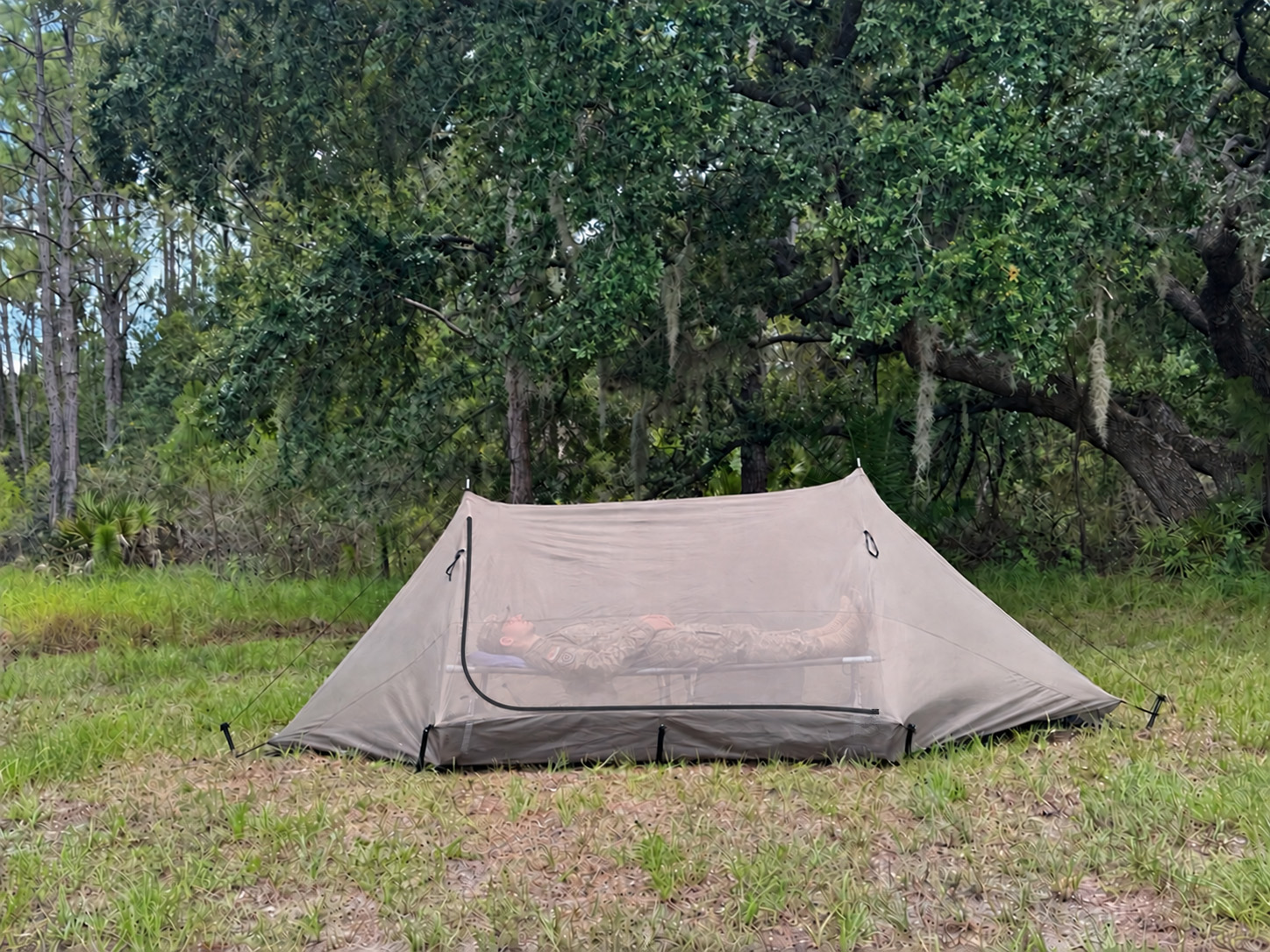
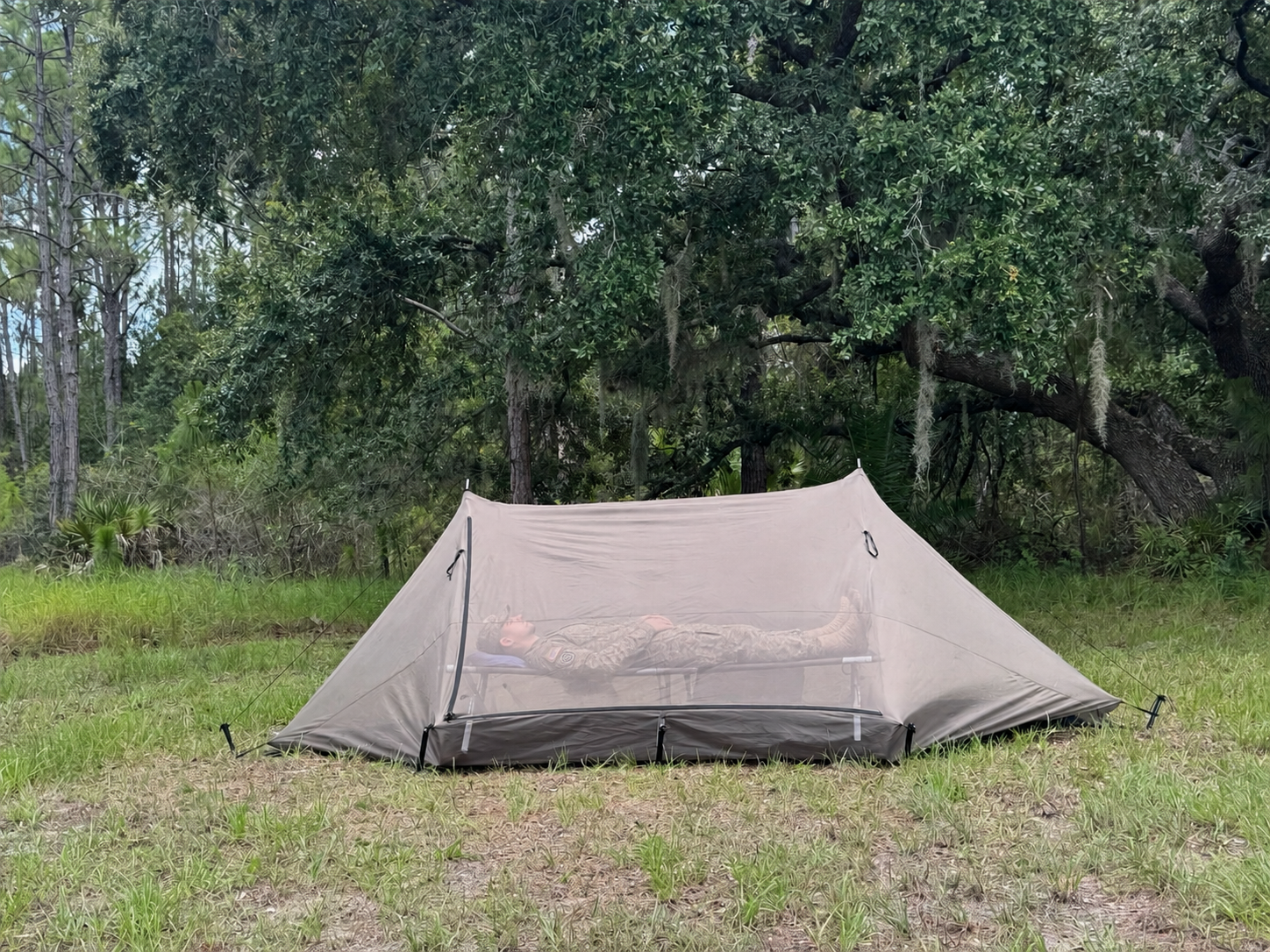
The Improved Insect Net Protector (Skeeta Bednet) is a lightweight, man-portable, fully enclosed personal insect protection shelter that improves upon the legacy Insect Net Protector (NSN 7210-01-520-7136, PN 180-007), by adding an integrated floor membrane, fine no-see-um mesh, a large L-shaped side zipper door, compact segmented poles, and multiple hold-down options. The enclosure protects the Soldier, sleeping system, cot, and essential gear from mosquitoes, midges, ticks, chiggers, ants, spiders, and other biting or nuisance pests during rest, recovery, and sleep periods
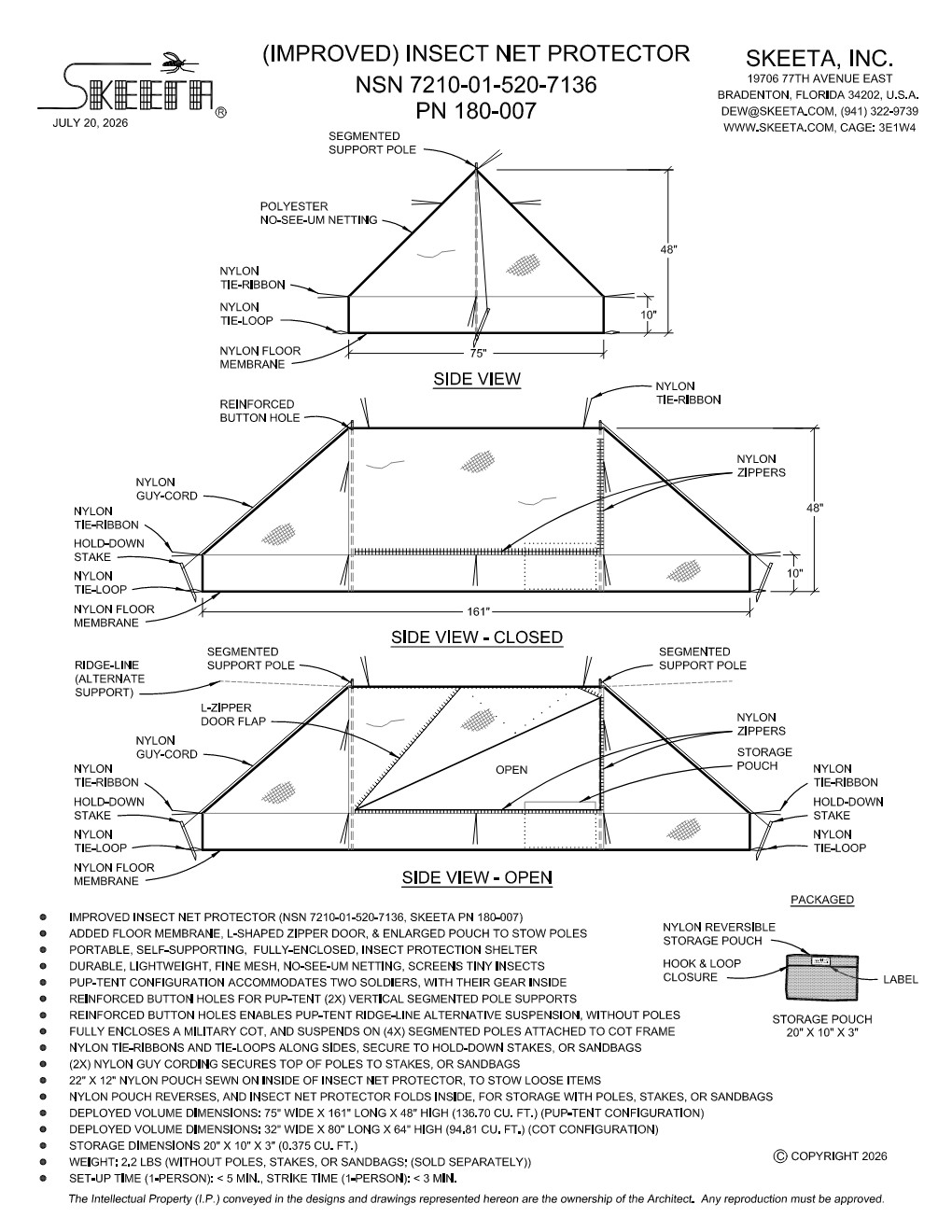
The Skeeta Improved Insect Net Protector is a lightweight, man-portable, fully enclosed personal insect protection shelter that improves the legacy Insect Net Protector (NSN 7210-01-520-7136, PN 180-007) by adding an integrated floor membrane, fine no-see-um mesh, a large L-shaped side zipper door, compact segmented poles, and multiple hold-down options.
The enclosure protects the Soldier, sleeping system, cot, and essential gear from mosquitoes, midges, ticks, chiggers, ants, spiders, and other biting or nuisance pests during rest, recovery, and sleep periods. Six straight pole sections assemble into two vertical supports for a 48-inch-high pup-tent configuration. The protected floor area is approximately 75 inches x 161 inches (61.46 sq. ft.) with approximately 136.70 cu. ft. of enclosed volume, large enough to fit a cot and gear. Eight 12-inch PVC stake hold-downs secure the system outdoors with two nylon guy lines; eight sandbag hold-downs allow use where staking is not permitted and support indoor use in billets, hangars, aid stations, or temporary facilities. The system stores in an attached pouch approximately 20 inches x 10 inches x 3 inches (0.375 cu. ft.). Total packed weight with poles and hold-downs is approximately 3.5 lb.; the net protector alone weighs approximately 2.2 lb. and can be deployed with a ridge line and field-improvised hold-downs to reduce carried weight.
At Maneuver Trials, dismounted infantry Soldiers can carry and employ the Skeeta Improved Insect Net Protector as individual protective equipment during patrol-base operations, tactical pauses, overnight rest, observation posts, field recovery periods, and temporary indoor billeting. The system requires no power, batteries, vehicle support, radio link, or electromagnetic emission. . It can be evaluated at the individual Soldier, squad, and platoon levels for setup time, packability, cot and gear compatibility, ventilation, ease of entry/exit, and Soldier confidence during rest in pest-exposed environments. Recommended basis of issue for field validation: one system per Soldier, with alternate deployment configurations tested under realistic light/dismounted conditions.
1. Net only (2.2 lb.): carried in a backpack and deployed with a ridge line and field-improvised hold-downs for the lightest field configuration.
2. Net with six pole sections and eight stake hold-downs (approximately 3.5 lb.): backpack-carried and deployed outdoors in a self-supporting pup-tent configuration.
3. Net with six pole sections and eight empty sandbag hold-downs (approximately 3.4 lb.): deployed where staking is not permitted, including hard ground, indoor spaces, or temporary facilities.
4. Net with eight pole sections and no separate hold-downs (approximately 2.6 lb.): deployed around a standard military cot in the field or indoors for cot-based rest and recovery.
Dismounted Soldiers often rest in field environments where mosquitoes, midges, ticks, chiggers, biting flies, ants, wasps, spiders, and other pests can penetrate sleep and recovery areas. Bites and stings can degrade health, sleep quality, alertness, comfort, and mission readiness; some vectors can transmit debilitating diseases such as Lyme disease, Rocky Mountain spotted fever, ehrlichiosis, and West Nile virus. Repellents and uniform treatments are valuable, but they do not create a sealed physical barrier around the Soldier and essential gear during sleep or recovery. Open-floor legacy netting can leave ground gaps, permit crawling pests, and require cot poles or improvised support. The Skeeta Improved Insect Net Protector addresses this capability gap with a fully enclosed, fine-mesh protective volume, attached floor membrane, large zipper entry, compact pole system, and flexible stake, sandbag, cot-frame, or ridge-line deployment. The intended military benefit is improved personal protection, better rest, reduced preventable pest exposure, and greater Soldier confidence in austere environments.
TRL 6 – field-tested prototype based on an existing issued Insect Net Protector configuration, with integrated improvements ready for Soldier evaluation in an operationally relevant field environment
Maneuver Trials 2027 Objective: Demonstrate and collect Soldier feedback on whether the Skeeta Improved Insect Net Protector provides a lightweight, rapidly deployable, fully-enclosed personal insect-protection capability for dismounted infantry without power, batteries, vehicles, or electromagnetic-spectrum dependence. Trial objectives are:
1. Measure one-Soldier setup and pack-up time for each deployment configuration.
2. Assess packability, carried weight, and suitability for light/dismounted infantry operations.
3. Evaluate protected volume for a Soldier, sleeping system, optional cot, and essential gear.
4. Assess the floor membrane, L-shaped zipper entry, ventilation, visibility, and ease of use with field clothing and equipment.
5. Compare stake, sandbag, cot-frame, and ridge-line deployment options in field and indoor conditions.
6. Identify durability, snag, repair, cleaning, storage, and user-interface issues after Soldier handling.
7. Compare Soldier preference and perceived protection against the legacy open-floor/coarse-mesh/wooden cot-pole Insect Net Protector configuration.
8. Determine recommended basis of issue and modifications needed before production or Army fielding.
Now we know that if the earthly tent we live in is dismantled, we have a building from God, an eternal house in heaven, not built by human hands. 2 For in this tent we groan, longing to be clothed with our heavenly dwelling, 3 becausewhen we are clothed,we will not be foundnaked.4 So while we are in this tent, we groan under our burdens, because we do not wish to be unclothed but clothed, so that our mortality may be swallowed up by life.
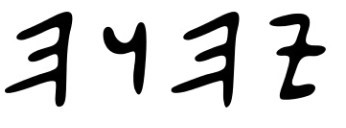
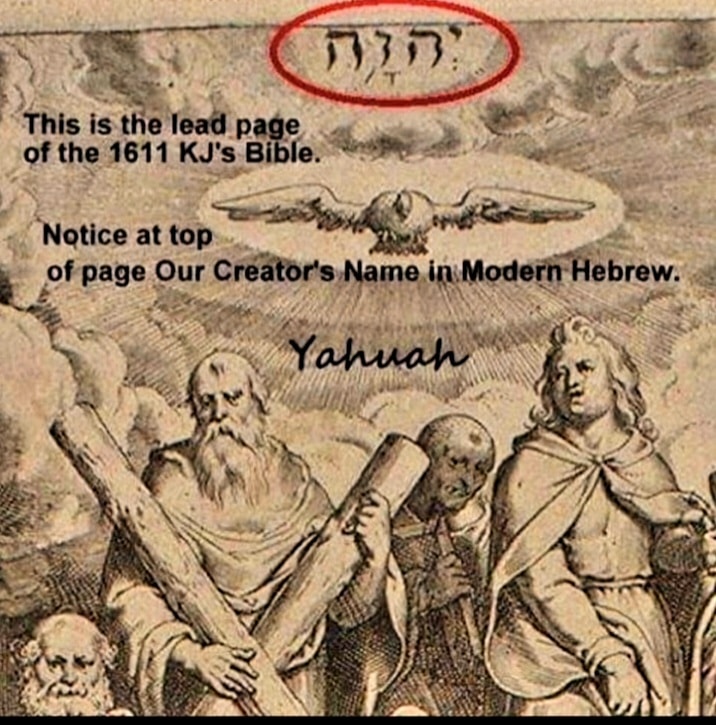
The Tetragrammaton is the four-letter Hebrew-language theonym יהוה (transliterated as YHWH), the personal name of God in the Hebrew Bible. The four Hebrew letters, written and read from right to left, are yod, he, vav, he; and pronounced Yahuah! . . . (inhale) Ya Hu (exhale) Wa Ha ! “Let everything the has breath praise Yahuah!”
I am no longer going to be in the world; and yet they themselves are in the world, and I am coming to You. Holy Father, keep them in Your name, the name which You have given Me, so that they may be one just as We are.
12 While I was with them, I was keeping them in Your name, which You have given Me; and I guarded them, and not one of them perished except the son of destruction, so that the Scripture would be fulfilled.
Then Moses asked God, “Suppose I go to the Israelites and say to them, ‘The God of your fathers has sent me to you,’ and they ask me, ‘What is His name?’ What should I tell them?” 14 GodsaidtoMoses,“I AMWHOI AM.This is whatyou are to sayto the Israelites:‘I AMhas sent meto you.’”15 God also told Moses, “Say to the Israelites, ‘YAHUAH (the LORD), the God of your fathers—the God of Abraham, the God of Isaac, and the God of Jacob—has sent me to you.’ This is My name forever, and this is how I am to be remembered in every generation.
The Tetragrammaton appeared nearly 7,000 times in scriptures, and then it was detramentally removed from the scriptures, and substituted for the man-made term “the Lord”, and mistakenly rendered and pronounced as Yahweh or Jehovah. (not good . . .)
So, when you are reading your Bible, where ever it is now written “the LORD”, (the substituted term), you should pronounce His Holy Name “YAHUAH” instead, as written in the original scriptures!
Hallelujah! Give praise, O servants of YAHUAH (the LORD); praise the name of YAHUAH (the LORD). 2 Blessedbethe nameof YAHUAH (the LORD) both nowand forevermore.3 From where the sun rises to where it sets, the name of YAHUAH (the LORD) is praised.
Migratory bird habitat degradation due to watershed hydrology on the north side of Chena Ridge being diverted into Cripple Creek Drain, a man-made mining gully, instead of naturally flowing into the original Cripple Creek Stream; is the restoration need this Five Star Grant project will address.
Star forts, or bastion forts, are 15th- to 19th-century, low-profile, star-shaped fortifications designed with angular bastions to counter cannon fire. Emerging in Italy, they feature thick, earth-filled walls and interlocking fields of fire, allowing defenders to eliminate blind spots and withstand artillery.
Arctic Food and Fresh Ice Security in Community Ice Cellars
Ice Cellar Experimental Research Tunnel (ICERT) in Fairbanks, Alaska will address the urgent need for food security in Arctic regions where ice cellars are being compromised by permafrost thaw due to global warming.
A permafrost tunnel will be excavated and a bermed pond created above a portion of the tunnel to measure and computer model the thermal effects from adding water to the surface, and storing ice inside the cellar.
The design will incorporate thermal siphons, and air vents to draw-in cold winter air and evacuate heat.
Ice blocks will be harvested from the fresh water pond, and placed inside the ice cellar to maintain below freezing temperature.
Indigenous knowledge of food preservation will be built upon to advance research and fill gaps in science for food and fresh ice security.
WATER ABOVE: Adding water on top of a portion of the tunnel to measure and computer model the thermal changes to the permafrost. Fresh water will be filled from a well into a pond, and water will be channeled through a ditch into Cripple Creek that meanders accross another zone above the ice cellar.
WATER INSIDE: Fresh ice will be havested from the pond and bought into the tunnel to measure the cooling effects.
FOOD STORAGE: Food storage lockers inside temperature controlled air vaults
PUBLIC TOURS: The public will have access inside the ice cellar for educational tours.
DEW Design Studiooo work produced at the University of Arkansas, School of Architecture, 2d & 3d Art studios, and Special Topics in Architecture at Prairie View A & M University, School of Architecture 1982 – 2002.
A plane is a flat surface that extends into infinity. It is also known as a two-dimensional surface. A plane has zero thickness, zero curvature, infinite width.
According to Google, an Arch is a curved symmetrical structure spanning an opening and typically supporting the weight of a bridge, roof, or wall above it.
The personal research and design blog of the architect of ArcticStar Design, Inc. Preparing to Test Galileo's hypothesis on Falling Bodies like never before – dropping spheres from the Edge of Space (EOS) – To Learn How a Gravity Field is Produced !!!!!!